The best emergency radios for hiking help you monitor severe-weather alerts, stay in contact with your group, and keep essential devices powered when you are away from reliable electricity.
This roundup compares 10 selected models across weather reception, power options, communication range, durability, and portability so you can choose equipment suited to your routes and emergency plan.
Best 10 Emergency Radios for Hiking Picks for 2026
Best Solar Power Bank Radio

- 7400mWh power bank for emergency device charging
- Solar, hand-crank, and AAA battery power options
- NOAA/AM/FM radio, flashlight, reading light, and SOS alarm
Best For: Hikers needing flexible power and several emergency tools
Best Rugged Two-Way Radios

- IP67 waterproof and dustproof construction
- MIL-STD-810H tested with two-meter drop protection
- Rechargeable 2000mAh batteries and weather alerts
Best For: Groups needing durable radio-to-radio communication
Best Lightweight Crank Radio

- Lightweight 7.84-ounce compact design
- NOAA/AM/FM reception with retractable antenna
- Solar, hand-crank, and rechargeable battery power
Best For: Day hikers prioritizing low weight and basic emergency functions
Best Budget Hiking Communication Set

- Two-pack with license-free FRS communication
- 22 channels, 38 privacy codes, and eVOX hands-free use
- NOAA weather scan and severe-weather alerts
Best For: Hiking pairs wanting affordable trail communication
High-Capacity Weather Radio
Mesqool 12000mAh NOAA Emergency Radio

- 12000mAh battery with solar, crank, USB-C, and AAA power options
- NOAA, FM, and AM reception with flashlight and reading lamp
- Large controls and non-slip grip for low-light operation
Best For: Extended camping, storm readiness, and high-capacity backup power
Waterproof Trail Communication
Motorola T605 H2O Two-Way Radios

- IP67 waterproof radios that float face up
- 22 channels and 121 privacy codes for group communication
- Rechargeable two-pack with USB-C charging and flashlight
Best For: Hiking groups needing waterproof two-way contact
Compact Splash-Resistant Pick
Leaton 10000mAh Hand Crank Radio

- 10000mAh battery with solar, hand-crank, and USB-C charging
- NOAA, AM, and FM reception plus three-mode flashlight
- IPX6 splash resistance, compass, and compact 1.1-pound design
Best For: Day hikes and emergency kits needing compact backup power
Best Two-Way Communication Pick
Baofeng AR-5RM 10W Two-Way Radios

- Two-radio set with up to 999 channels
- NOAA weather reception and emergency alarm
- USB-C charging plus included accessories
Best For: Hiking groups needing direct radio communication
Best Multi-Power Charging Pick
7400mWh Hand Crank Emergency Radio
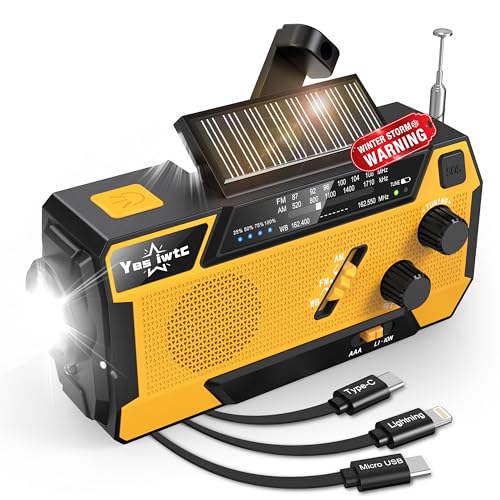
- Four charging methods, including solar and hand crank
- Built-in cables for Lightning, USB-C, and Micro USB
- NOAA weather band, flashlight, and reading lights
Best For: Outdoor preparedness with flexible backup power
Best Weather-Alert Pick
Eoxsmile NOAA Solar Hand Crank Radio
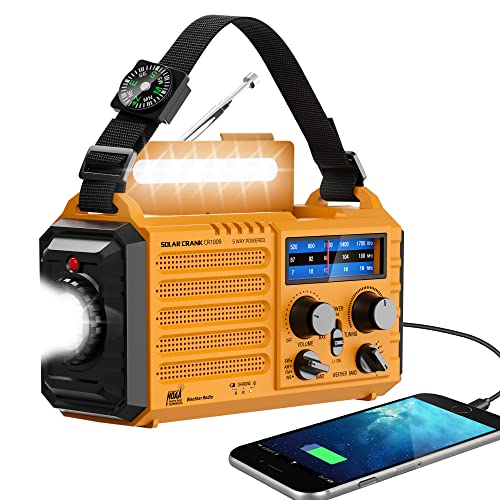
- NOAA alerts use sound and a flashing red light
- AM, FM, shortwave, and seven weather channels
- Solar, crank, USB-C, rechargeable, and AAA power
Best For: Hikers wanting broad weather coverage and alerts
Best Solar Power Bank Radio – FosPower A1 Emergency Radio
For hikers choosing emergency radios for hiking, the FosPower A1 combines NOAA, AM, and FM reception with several ways to restore power. Its hand crank, solar panel, and AAA battery support make it a practical choice when access to outlets is limited.
Best For: Hikers who want weather updates, emergency lighting, and backup phone charging in one device.
Pros:
- 7400mWh (2000mAh) power bank can provide emergency power to a phone or small tablet.
- Uses solar charging, a hand crank, and four AAA batteries for flexible power options.
- Includes NOAA/AM/FM reception, a 1W flashlight, four-LED reading light, and SOS alarm.
- Water-resistant design and limited lifetime warranty add practical reassurance.
Cons:
- Requires four AAA batteries when solar or hand-crank power is not sufficient.
- At 6.2 inches long and 310 grams, it is not the lightest option for minimalist hiking kits.
The FosPower stands out when power versatility matters as much as weather information. It is a feature-rich emergency radio for hiking, especially for longer trips or emergency kits where phone charging and multiple lights are useful.
Best Rugged Two-Way Radios – Retevis RB48 Walkie Talkies
The Retevis RB48 is a two-way communication option for hikers shopping for emergency radios for hiking. This two-pack is built for demanding conditions, with IP67 protection, MIL-STD-810H testing, rechargeable batteries, and weather-alert support.
Best For: Hiking partners or groups that need durable, direct communication in wet, dusty, or rough environments.
Pros:
- IP67 waterproof and dustproof construction with a stated two-meter drop rating.
- MIL-STD-810H testing covers drops, vibration, heat, cold, and other harsh conditions.
- Each radio uses a 2000mAh rechargeable battery rated for up to 20 hours of use.
- Includes 22 FRS channels, weather alert capability, USB-C charging, and a charging dock.
Cons:
- These are FRS walkie-talkies rather than broadcast weather radios with AM/FM reception.
- The two-radio set weighs 730 grams according to the supplied specifications.
Choose the RB48 when staying in contact with another hiker is the priority. Its rugged waterproof build and rechargeable setup are well suited to group hikes, though it complements rather than replaces a NOAA broadcast radio.
Best Lightweight Crank Radio – RunningSnail MD-088S
The compact RunningSnail MD-088S is an approachable pick for emergency radios for hiking when pack space and weight matter. It provides NOAA, AM, and FM reception, a 2000mAh rechargeable battery, solar and hand-crank charging, and a bright LED flashlight.
Best For: Day hikers and emergency kits that need a small radio with basic lighting and phone-charging capability.
Pros:
- Compact 5-by-1.8-by-2.4-inch body weighs 7.84 ounces.
- Supports NOAA, AM, and FM broadcasts with a retractable antenna.
- Offers three power sources: hand crank, solar panel, and built-in rechargeable battery.
- Includes a 2000mAh emergency charger and 1W LED flashlight.
Cons:
- Listed as water repellent rather than fully waterproof.
- Provides fewer lighting features than models with separate reading lights.
- Has a one-year manufacturer warranty.
The MD-088S is a sensible lightweight choice for hikers who want core emergency functions without a bulky device. Its compact design is particularly useful for daypacks, while the crank and solar options help extend standby readiness away from outlets.
Best Budget Hiking Communication Set – Midland T51VP3 Walkie Talkies
The Midland T51VP3 is a two-pack of license-free FRS walkie-talkies for hikers who need simple communication on the trail. It adds NOAA weather scan and alerts, 22 channels, privacy codes, and hands-free eVOX operation in a compact package.
Best For: Hiking pairs who want lightweight, direct communication plus basic severe-weather alerts.
Pros:
- License-free FRS operation with 22 channels and 38 privacy codes.
- NOAA Weather Scan automatically searches available weather channels and can issue alerts.
- eVOX provides hands-free communication with three sensitivity levels.
- Compact radios include belt clips and offer a stated battery life of up to 10 hours.
Cons:
- Not water resistant according to the supplied specifications.
- Uses an included AAA battery rather than a rechargeable battery system.
- Weather features are alerts and scanning; it does not provide solar or hand-crank emergency power.
The T51VP3 makes sense when trail communication is more important than charging phones or powering lights. Its NOAA alert feature is useful as a supplement, but hikers facing wet conditions may prefer a model with a stated waterproof rating.
High-Capacity Weather Radio – Mesqool 12000mAh NOAA Emergency Radio
For hikers who want a single device for weather updates, lighting, and backup power, this Mesqool model is one of the more capable emergency radios for hiking. It supports NOAA, FM, and AM reception and offers several ways to keep the battery supplied away from an outlet.
Best For: Extended camping trips, storm preparedness, and hikers who value a large battery and multiple charging options.
Pros:
- 12000mAh battery can provide backup power for a smartphone and extended radio or light use.
- Supports solar, hand-crank, USB-C, and three AAA batteries.
- Includes NOAA, FM, and AM reception, a flashlight, reading lamp, and SOS alarm.
- Large controls, a non-slip grip, and a 260-foot stated flashlight beam support practical use in low light.
Cons:
- At 6.8 x 2.9 x 4.7 inches, it is bulkier than a minimalist hiking radio.
- The supplied notes recommend fully charging the unit before first use.
This is a strong choice when battery capacity and versatile emergency functions matter more than minimizing pack weight. Its larger body may be better suited to a prepared daypack, vehicle kit, or base camp than ultralight outings.
Waterproof Trail Communication – Motorola T605 H2O Two-Way Radios
For groups that need to stay in contact rather than simply monitor broadcasts, these Motorola radios are a practical alternative among emergency radios for hiking. The two-pack uses FRS communication, includes rechargeable batteries, and is built for wet outdoor conditions.
Best For: Hiking partners, family groups, and outdoor teams that need direct two-way communication in rainy or water-prone environments.
Pros:
- IP67 waterproof design floats face up for easier retrieval if dropped in water.
- Offers 22 channels and 121 privacy codes, creating 2,662 channel-code combinations.
- Rechargeable batteries and dual USB-C charging add convenience in the field.
- Includes an integrated flashlight, backlit display, automatic squelch, and a stated maximum range of 35 miles.
Cons:
- These are two-way radios, not NOAA weather-broadcast receivers.
- The listed battery life averages about 9 hours.
- Maximum range can vary with terrain, obstacles, and conditions.
The T605 H2O is the better fit when coordination between hikers is the priority. Its waterproof, floating design adds useful protection around streams and wet weather, while rechargeable operation helps simplify group gear.
Compact Splash-Resistant Pick – Leaton 10000mAh Hand Crank Radio
The Leaton combines weather broadcasts, emergency lighting, and phone backup in a relatively compact package, making it a sensible option for hikers comparing emergency radios for hiking. It supports solar, hand-crank, and USB-C charging, while its built-in compass adds a basic outdoor navigation aid.
Best For: Day hikes, camping, RV trips, and emergency kits needing a compact radio with lighting and phone-charging capability.
Pros:
- 10000mAh internal battery provides backup power, with approximately 1–1.5 iPhone 14 charges depending on conversion and device efficiency.
- IPX6 water resistance protects against splashes and water spray.
- Includes NOAA, AM, and FM reception, plus a flashlight with high, low, and SOS modes.
- Compact 6.3 x 3.5 x 3.1-inch design weighs about 1.1 pounds and includes a compass.
Cons:
- NOAA stations require manual tuning; it does not provide SAME or automatic alerts.
- IPX6 protection is for spray and splashes, not immersion or heavy rain.
- One minute of steady cranking provides only about 15–20 minutes of radio listening, depending on use and speed.
This model offers a balanced feature set for hikers who want emergency information and basic power without carrying a full-size preparedness radio. Its manual NOAA tuning and splash-only protection are important limitations to understand before heading into severe weather.
Best Two-Way Communication Pick – Baofeng AR-5RM 10W Two-Way Radios
For hikers who need communication between group members, the Baofeng AR-5RM two-pack is a feature-rich option among emergency radios for hiking. It offers up to 999 channels, NOAA weather reception, multiple charging options, and included speaker microphones, though its lack of water resistance calls for careful packing in wet conditions.
Best For: Hiking groups, hunting parties, and campers who need two-way communication and weather updates.
Pros:
- Two radios included, with up to 999 storage channels.
- NOAA weather receiver helps monitor severe-weather information.
- USB-C, wall, and other charging options support flexible field use.
- Includes speaker microphones, earpieces, belt clips, and programming cable.
Cons:
- Not water resistant, according to the supplied specifications.
- Battery life is listed at approximately six hours.
- Ham-radio functions may require programming and appropriate authorization.
Choose this set when direct group communication matters more than simplicity. Its accessories and NOAA capability add versatility, but hikers should protect the radios from rain and learn the controls before heading out.
Best Multi-Power Charging Pick – 7400mWh Hand Crank Emergency Radio
This hand-crank model is a practical choice for hikers who want emergency radios for hiking with several backup power options. Its rechargeable battery, solar panel, hand crank, AAA-battery support, built-in charging cables, weather reception, and lighting functions make it useful when access to outlets is limited.
Best For: Campers and hikers who prioritize backup power, weather broadcasts, and built-in lighting.
Pros:
- 7400mWh battery can provide emergency power for compatible devices.
- Charges through USB-C, solar power, hand crank, or AAA batteries.
- Includes built-in Lightning, USB-C, and Micro USB cables.
- Offers NOAA, AM, and FM reception plus flashlight and reading lights.
Cons:
- Analog display may be less precise than a digital tuner.
- Hand-crank and solar charging are backup methods rather than fast primary charging.
- Its charging cables and larger battery may add bulk compared with a basic radio.
The combination of power redundancy and lighting makes this a strong preparedness tool for campsites and emergency kits. It is especially appealing when you want one compact device to handle weather updates, illumination, and limited device charging.
Best Weather-Alert Pick – Eoxsmile NOAA Solar Hand Crank Radio
The Eoxsmile combines weather alerts, multiple radio bands, and emergency lighting in a portable design suited to emergency radios for hiking. Its NOAA alert function can sound and flash when severe-weather information is issued, while solar, hand-crank, USB, rechargeable-battery, and AAA-battery options provide several ways to keep it operating.
Best For: Hikers and campers who want automatic weather alerts, broad radio-band coverage, and a compass.
Pros:
- NOAA alert mode provides an audible alarm and flashing red light.
- Supports AM, FM, shortwave, and seven NOAA weather channels.
- Five power options include solar, hand crank, USB-C input, rechargeable battery, and AAA batteries.
- Includes a flashlight, reading lamp, USB output, compass, and headphone jack.
Cons:
- AAA batteries are backup power and are not included.
- The power adapter is not included.
- Weather-alert reception depends on local broadcast availability and signal conditions.
This is a versatile pick for hikers who value advance weather notifications and more listening options than AM/FM alone. Its compass, lighting, and charging output add useful trail functions, while the multiple power sources support longer-term emergency readiness.
How We Picked the Best Emergency Radios for Hiking
We organized these picks around the jobs a hiking radio may need to perform: receiving NOAA weather information, supporting group communication, providing backup power, and remaining usable in changing outdoor conditions. The selection includes dedicated hand-crank weather radios, FRS walkie-talkie pairs, waterproof communication radios, and more versatile handheld models.
We also considered practical details such as rechargeable or replaceable power, solar charging, built-in flashlights, alert functionality, water resistance, radio licensing requirements, weight, and ease of operation. Specifications can vary by configuration, so verify the current listing before buying, especially for range, battery capacity, and charging accessories.
Quick Comparison
- Best for weather monitoring: Choose a NOAA weather radio with alert support, a clear display or controls, and multiple backup charging methods.
- Best for group communication: FRS two-way radio pairs are generally simpler for hiking partners because they are designed for license-free consumer use in the United States.
- Best for wet conditions: Look for waterproof or clearly stated water-resistance ratings rather than assuming a radio is protected because it is marketed for emergencies.
- Best for backup power: Hand-crank and solar models can provide reassurance when outlets and spare batteries are unavailable, although charging by hand is slow.
- Best for advanced users: A programmable handheld radio may offer greater flexibility, but it can require configuration, compatible frequencies, and appropriate licensing.
Key Buying Factors for Emergency Radios for Hiking
Weather Alerts and Reception
Prioritize NOAA reception and an alert mode if your main concern is storms, flash flooding, or rapidly changing conditions. Test the radio before a trip and learn how to switch bands, adjust volume, and access alerts without relying on the manual.
Power and Charging
Compare battery capacity with charging methods. USB charging is convenient, while solar panels and hand cranks are useful as backup systems rather than guaranteed primary power sources. Carry a charged power bank or spare batteries when the route permits.
Communication Range and Terrain
Advertised range is typically measured under favorable conditions. Trees, ridgelines, buildings, and weather can reduce performance substantially. For hiking groups, prioritize clear operation and battery life over the largest headline range.
Durability and Portability
Water protection, impact resistance, a readable display, tactile controls, and a secure lanyard or clip matter more on a trail than extra features you will not use. Check weight and dimensions before adding the radio to a small pack.
Who Should Buy Which Emergency Radios for Hiking?
Solo hikers and emergency-preparedness users should favor compact weather radios with NOAA alerts, a flashlight, and multiple charging options. Couples or groups that need routine trail communication should choose an FRS pair, ideally with a durable housing and straightforward controls. Hikers in wet environments should select a model with an explicitly stated waterproof rating. Experienced radio users may prefer a Baofeng-style handheld for expanded capabilities, but should confirm local regulations and learn the required operating procedures first.